
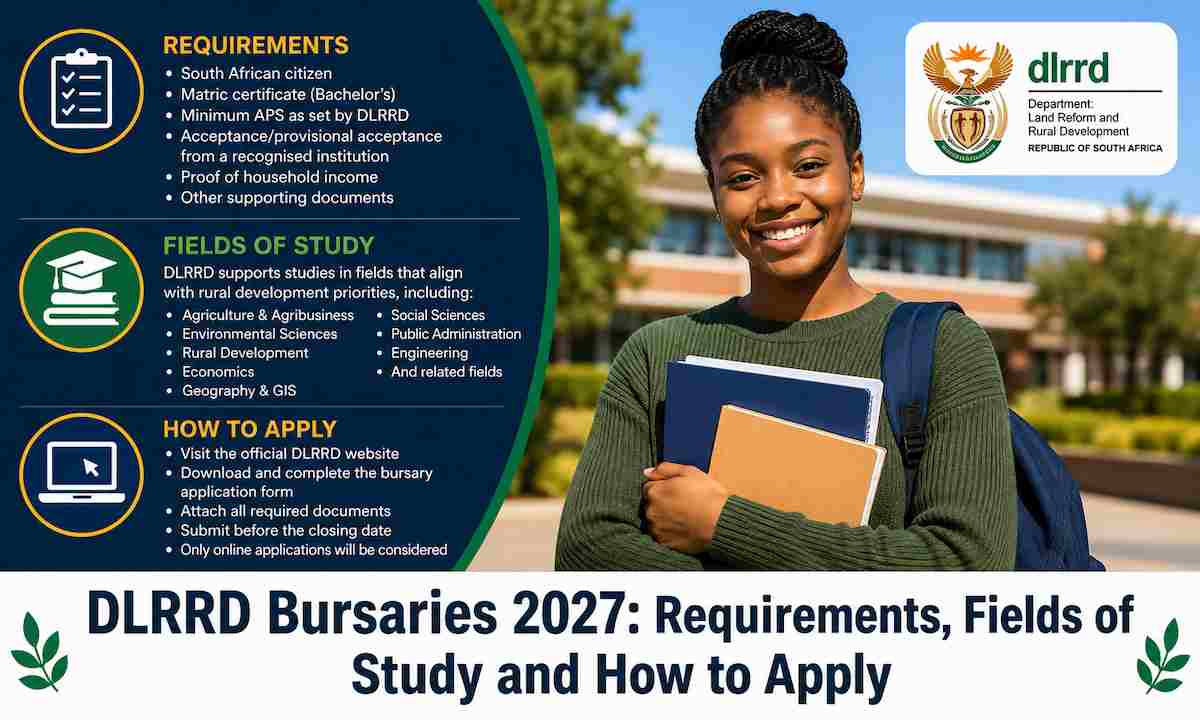
The Department of Land Reform and Rural Development (DLRRD) has opened bursary applications for 2027.
The DLRRD Bursary Programme supports qualifying South African students pursuing selected qualifications.
In particular, the programme focuses on land administration, surveying, geomatics, GIS and planning.
Applications are open to students from previously disadvantaged backgrounds and rural communities.
The bursary provides financial support for approved full-time studies at recognised South African universities.
The closing date for applications is 30 September 2026.
DLRRD Bursary Programme 2027
The DLRRD bursary aims to support students entering fields relevant to the department’s work.
Therefore, applicants must choose an approved qualification before submitting an application.
The programme supports undergraduate and selected postgraduate studies.
Furthermore, students must study full-time at a recognised and accredited South African university.
The bursary applies to the 2027 academic year.
Fields of Study Covered by the DLRRD Bursary
Applicants can apply for funding in several approved study areas.
These fields include:
- BSc Geo-informatics
- BSc Geographic Information Science
- Diploma in Geomatics
- Diploma in Surveying
- Diploma in Geographic Information Systems
- BSc Land Surveying
- BSc Geomatics
- Town Planning
- Urban Planning
- Regional Planning
- Relevant Town, Urban and Regional Planning degrees
- Relevant Town, Urban and Regional Planning diplomas
- Approved postgraduate studies in Geomatics and Planning
However, applicants should confirm that their chosen qualification falls within the approved fields.
What Does the DLRRD Bursary Cover?
Successful applicants can receive financial assistance toward several study-related expenses.
The bursary covers:
- Full tuition fees
- Accommodation
- Books and study materials
- Meals
- Living allowance
Consequently, the programme can reduce many of the costs associated with full-time university study.
Who Can Apply for the DLRRD Bursary?
Applicants must meet the programme’s eligibility requirements.
You must be a South African citizen to qualify.
Additionally, you must come from a previously disadvantaged background or rural community.
Applicants may currently be in Matric or have already completed Matric.
You must also study, or intend to study, full-time in an approved field.
Furthermore, your university must be recognised and accredited in South Africa.
Applicants must meet the academic requirements for their chosen qualification.
Department of Land Reform and Rural Development employees cannot apply.
DLRRD Bursary Academic Requirements
The required marks depend on the qualification selected.
For relevant BSc applications, applicants must achieve at least Level 5.
This means a minimum mark of 60–69% in Mathematics is required.
Applicants must also achieve Level 5 in Physical Science or Geography.
For relevant bachelor’s degrees and diploma applications, applicants need at least Level 4.
This represents 50–59% in Mathematics.
Applicants also need Level 4 in Physical Science.
Therefore, students should carefully check the academic requirements before applying.
Documents Required for the DLRRD Bursary
Applicants must prepare supporting documents before completing their applications.
Required documents include a certified copy of your South African ID.
The ID copy must not be older than three months.
Applicants must also provide certified copies of their parents’ or guardians’ IDs.
Current Matric learners should submit certified Grade 11 final results.
They should also include their latest available Matric results.
Students who completed Matric must provide a certified Matric certificate.
Current university students must submit recent certified academic transcripts.
Additionally, applicants should provide proof of university registration or acceptance.
Proof of address must also accompany the application.
Applicants without final results or university acceptance may still apply.
However, the outstanding documents must be submitted later according to the application instructions.
How to Apply for the DLRRD Bursary 2027
Applicants can use the available online or email application method.
However, applicants should select only one application method.
For online applications, applicants should follow the official DLRRD application instructions.
Alternatively, applicants can download and complete the official bursary application form.
The completed form and supporting documents can then be sent by email.
The supplied email address is Externalbursaries@dlrrd.gov.za.
Use DLRRD Bursary Application 2027 as the email subject.
Applicants should not submit duplicate applications through both methods.
DLRRD Bursary Closing Date 2026
The application deadline is 30 September 2026.
Applicants should submit their applications before the closing date.
Late applications will not be accepted according to the supplied information.
Therefore, students should prepare their documents well before the deadline.
Final Words
The DLRRD Bursary Programme 2027 offers financial support for selected university qualifications.
The programme particularly supports studies linked to geomatics, surveying, GIS and planning.
Eligible students should review the requirements carefully before applying.
Most importantly, applicants should submit complete and accurate supporting documents.
Closing Date: 30 September 2026
Disclaimer
SETAWeb is an independent South African careers and opportunities website. We are not affiliated with the Department of Land Reform and Rural Development (DLRRD), the South African Government, or any organisation involved in administering the DLRRD Bursary programme. The DLRRD Bursaries 2027 information published on this website is provided for educational and informational purposes only. Applicants should always verify the eligibility requirements, fields of study, required documents, funding benefits, closing date and application process through the official DLRRD platform or relevant government sources before applying.

Hope Johnson
Hope Johnson is the Founder and Lead Content Editor of SETAWeb, a South Africa–based digital platform focused on education, SETA programmes, learnerships, bursaries, internships, and career opportunities. She has extensive experience researching, verifying, and publishing accurate information sourced from official SETAs, government departments, universities, and public sector institutions. Contact: info@setaweb.co.za